Dr. Aniruddha Malpani • 23 October 2025 • 5 min read
Why Indian Graduates Struggle to Think for Themselves
A frank dialogue on how rote-first coaching creates compliant graduates-and why autonomous, AI-guided learning rebuilds real problem solving.
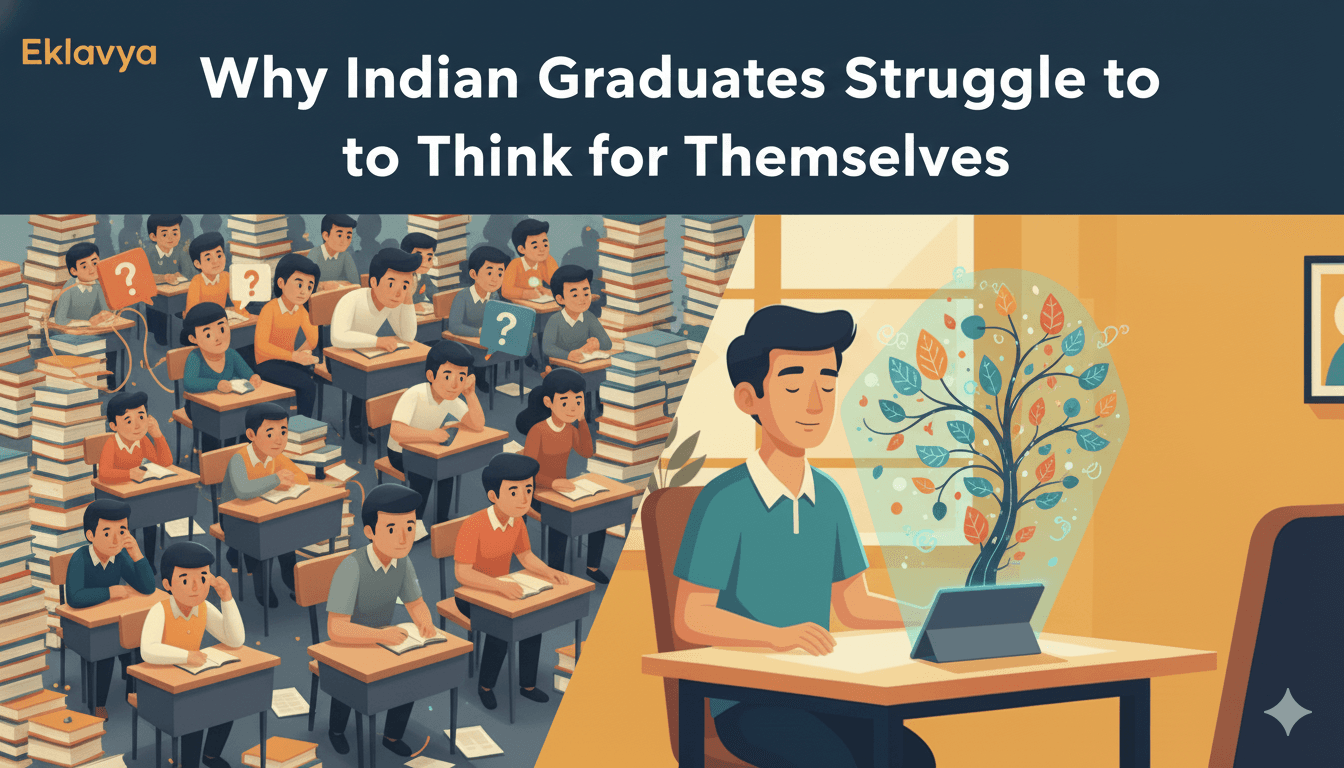
Business Owner: Dr. Malpani, I run a tech company, and hiring these days is a nightmare. Every résumé looks impressive - degrees, marks, certificates - but when I interview them, it’s like talking to parrots. They can repeat definitions, but they can’t apply anything. Ask them to think creatively or solve a new problem, and they freeze.
Dr. Malpani: You’ve just described the biggest side effect of our current education system - manufactured mediocrity. Coaching classes and rote-based schooling have trained students to memorize, not to think. They don’t learn how to learn - they just learn how to pass.
Business Owner: That’s exactly what I’m seeing. I ask candidates how they’d approach a real-world problem, and they just look lost. They’re waiting for me to tell them what to do.
Dr. Malpani: That’s because they’ve spent years in systems that punish questioning and reward blind obedience. Most of them have spent their teenage years in commercial coaching factories - where learning is simulated, not experienced.
They sit in overcrowded classrooms, listening passively to lectures, cramming for exams, and memorizing shortcuts. It’s like intellectual fast food - it fills you up for the test but leaves you malnourished for life.
Business Owner: It’s frustrating. We spend months training them on basics they should’ve mastered in college. And even then, they can’t connect theory with practice.
Dr. Malpani: Because they never understood the theory. Coaching classes don’t teach understanding; they teach cramming and compliance. They drill formulas into memory without explaining why they work. Students are taught to chase ranks, not knowledge.
So, when they finally enter the workplace, they expect someone else to hand them a syllabus, deadlines, and model answers. But real life doesn’t come with an answer key.
Business Owner: I guess that’s why even engineering graduates can’t write clean code or reason logically unless you spoon-feed them.
Dr. Malpani: Exactly. Their entire education was about answering questions, not asking them. That’s why India produces millions of graduates every year - and yet companies like yours still struggle to find people who can think independently.
This isn’t an individual failure. It’s a systemic design flaw. Coaching classes were never meant to create thinkers - they were designed to produce test-crackers.
Business Owner: And the irony is, parents are spending a fortune on this nonsense - believing it’s the path to success.
Dr. Malpani: That’s the tragedy. Coaching institutes market fear - “Without us, your child won’t get into IIT.” Parents, anxious to do the best for their kids, pay lakhs hoping it’s an investment in their future. But what they’re really buying is intellectual paralysis.
The students emerge with marks but without mastery. The system turns potential innovators into obedient clerks.
Business Owner: So what’s the alternative? How do we fix this mess?
Dr. Malpani: The answer isn’t more coaching - it’s more autonomy. We need to give students control over how they learn, at their own pace and in their own way.
That’s where AI tutors like app.jee.eklavya.io come in. These tools offer personalized, self-paced learning that helps students truly understand concepts, not just cram them.
Unlike coaching classes, AI tutors:
- Let students learn anytime, anywhere.
- Provide instant feedback without judgment.
- Adjust difficulty levels based on progress.
- Encourage exploration, curiosity, and problem-solving.
When students take charge of their learning, they stop being passive recipients and start becoming active creators of knowledge.
Business Owner: You mean students can learn the same material - like JEE-level physics or math - without coaching?
Dr. Malpani: Absolutely. Everything needed to master those subjects is freely available - high-quality explanations, practice questions, and simulations. What students need isn’t more information - it’s a system that helps them use that information intelligently.
AI tutors do exactly that. They act like a mirror - reflecting what the student knows, what they don’t, and how they can improve.
It’s not just exam prep; it’s brain training. They build habits of thinking, analyzing, and connecting ideas - skills that last long after the exam is over.
Business Owner: If students grew up using something like that, I’d finally get employees who can think on their feet!
Dr. Malpani: And that’s the vision - to create a generation of learners who don’t wait for instructions but seek out solutions. The future of education isn’t about memorization; it’s about metacognition - learning how to learn.
When students learn independently, they develop exactly the traits employers crave: curiosity, initiative, and critical thinking.
Business Owner: You know, if every kid used AI tutors instead of going to coaching classes, we might actually have an employable workforce in ten years.
Dr. Malpani: That’s the goal. The classroom model belongs to the 20th century. The future of learning is self-directed, personalized, and intelligent.
Once students learn how to learn, no syllabus or exam will ever intimidate them again - and no employer will ever complain that “graduates can’t think.”
Final Thought
Coaching classes simulate learning - AI tutors enable it. If we want India’s youth to be thinkers, not test-takers, we need to give them tools that build understanding, not anxiety.
Help us improve India’s first free AI Tutor for JEE students at app.jee.eklavya.io! We want students to become independent, self-directed lifelong learners.
Keep exploring
More from the Eklavya learning desk
Continue the journey with reflections on independent learning, coaching myths, and smarter JEE prep.
What IndianPotholes.com Taught Me About Shipping Early, Caring Deeply, And Living With An Unfinished Project
A personal story about building India's first pothole tracking platform, the fears of launching publicly, fixing production bugs on tea breaks, and why unfinished projects can shape you more than perfect ones.
How I Ended Up Working With Dr Malpani
A long, honest story about fear, luck, talent, chance, growth, and a man who changed my life. From night shift call center employee to Entrepreneur in Residence at Malpani Ventures.