Roshan Singh • 4 December 2025 • 9 min read
What IndianPotholes.com Taught Me About Shipping Early, Caring Deeply, And Living With An Unfinished Project
A personal story about building India's first pothole tracking platform, the fears of launching publicly, fixing production bugs on tea breaks, and why unfinished projects can shape you more than perfect ones.

Before I get into anything, let me admit something simple. I was not planning to write about IndianPotholes.com at all. I had quietly accepted that the project lived its life, taught me what it had to teach, and moved into the background. But Dr Malpani has a habit of nudging me into doing things I conveniently avoid. He asked me to write this story, and when he insists, it is very difficult to escape. So if you enjoy this article, you can give him credit. If you think it is too long or too honest, you can blame him for that as well.
After I shared the story of how I began working with him, a lot of people asked what happened to IndianPotholes.com after that big launch. People saw the tweet, the excitement, the flurry of attention. From the outside, it looked like a clean arc - someone suggests an idea, a young builder executes it, the internet cheers, and everything falls neatly into place.
Real life, of course, is different.
IndianPotholes.com did not become a unicorn. It did not fix every pothole in India. It also did not disappear or shut down. It settled somewhere in the middle - alive, useful, but quieter than its first week. For me, it became something else entirely - a mirror that showed me my fears, my limits, my instincts, and my values.
This is the story of that journey.
The early days - when perfection felt safer than launching
IndianPotholes began with a single tweet from Dr Malpani. A simple suggestion - someone should build a platform to track potholes. It looked casual on the timeline. But to me, sitting in Mumbai after a night shift, practicing JavaScript in tired silence, it felt like a challenge I suddenly wanted to take.
I replied that I would build it.
From the moment I replied, our philosophies diverged a little:
- He believed in launching early and adjusting quickly
- I believed in polishing, refining, testing, and avoiding mistakes
- He wanted real feedback as soon as possible
- I wanted to protect myself from embarrassment
On every call he would say some version of the same message - "Just release it. Let people tell you what is wrong. You will learn faster."
I agreed with him in theory and then promptly did the opposite in practice.
I was a new-ish engineer, and the idea of strangers using my code made me nervous. When you work privately, you only answer to yourself. When you ship publicly, everything becomes visible - your decisions, your shortcuts, your errors. That visibility is uncomfortable when you are not used to it.
Days passed like that. He would ask how far along we were. I would say "almost done." But almost can stretch infinitely when fear does the timekeeping.
Eventually I realized something important - if I kept delaying, I would lose the trust he had placed in me. That mattered more than my fear.
So I pushed through the discomfort and deployed.
That is how IndianPotholes.com quietly went live for the first time.
The launch day - excitement mixed with anxiety
The public launch happened through his tweet. He announced India's first crowdsourcing platform to report potholes, tagged me, and invited the world to try it.
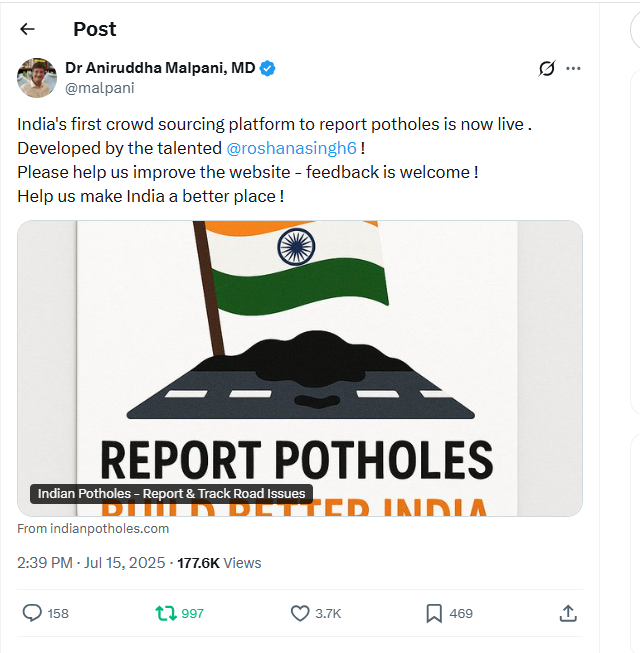
My first reaction was not pride. It was worry.
Now people could see the work. Now there was no hiding behind "still refining." The project was out there, with my name attached to it, while I was still working a night shift at a call center.
Phones were not allowed on the floor, so my launch day did not look like a founder's photo on a laptop with analytics on the side. It looked like:
- logging into the support system
- handling printers that refused to print
- talking to frustrated customers
- waiting for a break to check if the site was still standing
During one break, I finally opened Twitter.
There were likes, retweets, and supportive comments. People appreciated the idea and said they wanted to try it.
For a moment, I felt a burst of joy. Something I built was being used in the real world.
Then I kept scrolling.
The first bug - and the lesson I learned on a tea break
A few messages were different.
"I tried submitting but it failed." "Getting an error after uploading a photo." "Something seems off with the form."
My stomach tightened.
All my earlier hesitation came rushing back in that moment. And yet, the irony was clear - polishing endlessly had not prevented bugs. Real usage exposes things you cannot predict.
I did not have a laptop. I did not have logs open. I did not have a team.
I had a phone, ten minutes of break, and a production bug.
From the symptoms, I guessed it was a rate limit or configuration issue triggered by the sudden wave of traffic.
So right there in the office breakout area, with people drinking tea around me, I opened my code editor on the phone, made the necessary changes, and pushed to GitHub.
A few minutes later, submissions started working again.
It was a tiny technical fix. But it shifted something inside me. I realized:
- bugs are not failures
- imperfection is part of building
- real feedback is invaluable
- discomfort is a sign that you are growing
I went back to my desk feeling strangely calm.
When people showed up to support the project
Once the issues were resolved, the momentum continued.
People shared screenshots of their submissions. Volunteers messaged offering help. My account barely had a few hundred followers, yet our posts were getting lakh level impressions.
It felt surreal. I had built projects before, but no one ever noticed them. This time, strangers were interacting with my work and thanking me for making it.
Among the messages was one from Shashank, a developer from Bangalore. He offered to build a mobile app for IndianPotholes. I agreed immediately.
There was no formality, no contract. Just two people working toward a shared purpose. In two weeks, he had a fully functional Android app ready. We refined it and launched it. The response again was heartwarming.
It showed me how much can happen when people choose to act instead of only discussing.
Organising goodwill - and discovering the limits of enthusiasm
As interest grew, so did offers to contribute.
I set up a Google Form and created a Telegram group. In the early days, the group was full of ideas. People discussed features, data visualizations, workflow automation, partnerships with local bodies, and long term roadmaps.
But enthusiasm is not the same as consistency.
People naturally became busy. Some stayed, others drifted back to their responsibilities, and discussions quieted slowly. Nothing dramatic, just the natural settling of energy that happens when life pulls people in different directions.
At one point, someone said the group needed a full time leader who could guide everything. I understood their perspective, but I also knew my reality. I could not dedicate every hour to this project while supporting my family and balancing other commitments.
This conversation taught me something important.
You can care deeply about your country and still choose stability. You can want to solve civic problems and still prioritize your responsibilities. These things can exist together without guilt.
It also made me understand how much civic tech depends on systems, not individuals. A project cannot run on passion alone. It needs structure, workflows, partnerships, and time.
Facing the larger realities of India's systems
Building the platform was the easy part. Getting potholes actually fixed was the hard part.
We tried contacting municipalities and exploring collaborations. Some were responsive, many were overwhelmed, and others simply could not integrate with citizen data at that moment.
For a while, we manually forwarded complaints. It worked at small scale but could never become a long term solution.
IndianPotholes showed me that technology can highlight a problem, but it cannot single handedly solve structural issues. For that, you need cooperation, processes, and official engagement.
But even without solving everything, the project started conversations. It raised awareness. It made people think differently. And sometimes, that is a meaningful beginning.
The project slows down but does not disappear
Eventually, the initial buzz softened.
The Telegram group went quieter. Reports became less frequent. New issues attracted public attention. The excitement faded, as excitement often does.
But IndianPotholes did not die.
The website is still live. Reports still come in. People still use it when they need to.
To me, it feels like a dormant project rather than a concluded one - something resting, waiting to be extended properly when the time and structure align. Perhaps under the Empowered Indian umbrella, it will find a renewed purpose.
What I learned from this journey
IndianPotholes taught me lessons that no classroom or tutorial could teach.
1. Shipping early teaches faster than perfect planning Polishing in private does not replace feedback from real users.
2. Mistakes are part of the process, not the end of it Fixing production from my phone changed my relationship with failure.
3. People genuinely want to help The kindness and energy of volunteers showed me how much potential exists when citizens care.
4. Sustainability matters more than excitement Civic tech needs systems, not just passion.
5. Impact can be quiet and slow Not every project changes the world loudly. Some change it quietly, one report at a time.
Was it worth it
Absolutely.
It shaped me. It built my confidence. It connected me with talented people like Shashank. It played a role in how I ended up working with Dr Malpani. It gave me a story I will carry for a long time.
IndianPotholes may not be in the spotlight today, but it is still part of my journey. It still lives online, quietly helping people, still reminding me of the day I took a chance on myself.
And if you are reading this with an idea in your head and fear in your stomach, I hope this encourages you.
Ship something small. Let the world see it. Let it teach you. Let it push you forward.
Even unfinished projects can shape you more deeply than perfect ones ever will.
Keep exploring
More from the Eklavya learning desk
Continue the journey with reflections on independent learning, coaching myths, and smarter JEE prep.
How I Ended Up Working With Dr Malpani
A long, honest story about fear, luck, talent, chance, growth, and a man who changed my life. From night shift call center employee to Entrepreneur in Residence at Malpani Ventures.
AI Tutor vs Commercial Coaching Classes – Which Helps Students Learn Better?
A comprehensive Q&A exploring why AI tutors are transforming education and replacing expensive, overcrowded coaching classes.